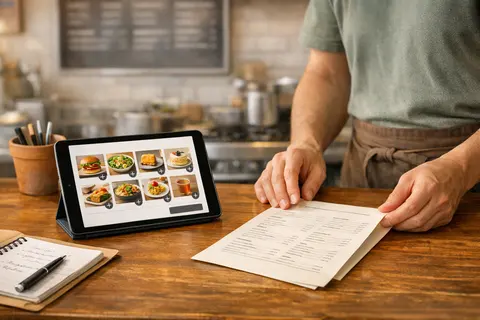
The customer who searches your menu is already close to ordering
Not every useful search is a huge discovery search like "best tacos near me."
For many restaurants, the more valuable search is simpler:
- your restaurant name plus "menu"
- your restaurant name plus "order online"
- your restaurant name plus "delivery"
- a specific dish people remember from a previous visit
Those searches usually come from customers who already know you. They are not asking to browse every restaurant in town. They are trying to get to the right menu and make a decision quickly.
That is why restaurant menu SEO should start with your own ordering page.
If the clearest menu result is a marketplace page, a stale PDF, or a social profile that cannot take an order, the customer has to do extra work before they can buy from you. A direct ordering page gives that intent a cleaner place to land.
Your menu page should be the stable source of truth
A strong ordering page does not need to be fancy. It needs to be dependable.
That means the page should answer the questions customers actually bring to it:
- What can I order right now?
- What does it cost?
- Is pickup available?
- Is delivery available?
- Are the hours current?
- Can I finish the order without switching apps?
When those answers live in one stable place, the restaurant has something worth linking to from its website, social profiles, QR codes, receipts, and staff replies. The menu stops being scattered across screenshots, PDFs, and third-party listings.
That consistency matters operationally too. If a customer calls because an old menu showed the wrong price, staff lose time explaining the mismatch. If a customer starts on a marketplace menu and sees a different total than expected, the restaurant can get blamed for a pricing experience it does not fully control.
Owned menu SEO is partly about search visibility. It is also about reducing confusion.
Write menu content for real customers, not keywords
Restaurant owners do not need to turn every item into a blog post. But item names and descriptions should be clear enough that a hungry customer can make a confident choice.
Good menu content usually has a few simple traits:
- recognizable item names
- short descriptions for dishes that need context
- clear modifiers and add-ons
- current prices
- honest pickup or delivery availability
- no vague filler that makes the menu harder to scan
The goal is not to stuff the phrase "best restaurant online ordering" into every line. The goal is to make the page useful for the customer and understandable for search systems.
A direct ordering page is especially helpful because the menu content and ordering action live together. The customer does not read one page, open another app, search again, and hope the same items are there. The menu can move directly into checkout.
Marketplaces can help discovery, but they should not own every reorder
Marketplaces can still have a role. A customer may discover a restaurant through DoorDash, Uber Eats, Grubhub, or another channel and then come back later because they liked the food.
The problem is when every future order stays trapped in that rented path.
If a customer already knows the restaurant name, the restaurant should make the direct option easy to find. That direct option gives the operator more control over menu presentation, pricing decisions, customer handoff, and the repeat-order habit.
This is the key distinction:
- discovery demand can come from many places
- branded demand should have a home the restaurant controls
Menu SEO helps protect that second category. It gives repeat customers a clear route back to the restaurant instead of sending them through whichever listing happens to appear first.
Make fulfillment details impossible to miss
A restaurant ordering page should not make customers guess how the order will be handled.
Pickup and delivery details deserve the same clarity as the food itself. If pickup is the main fulfillment path, say that plainly. If delivery is available only within a compact radius or only when capacity exists, the ordering experience should make that obvious before checkout.
That is especially important for direct ordering because trust builds in small moments. Customers notice when the menu is current, the hours make sense, the ordering flow is clean, and the final handoff matches what the page promised.
Good menu SEO gets the customer to the page. Good operations make them comfortable placing the order.
Where OmNom fits
OmNom is built for restaurants that want their own direct ordering channel without adding another commission layer to every order. Restaurants pay no OmNom commission and no monthly platform fee. Standard Stripe processing still applies.
That makes the direct-ordering page easier to treat as a long-term asset instead of a side experiment. It can be the place customers use when they search your menu, when they scan a QR code, when they click from Instagram, or when staff send someone the ordering link.
OmNom can also help with the menu setup work that often slows restaurants down. That matters because SEO and ordering both depend on the same foundation: a clean, accurate menu customers can trust.
If you are deciding what to fix first, start with the direct ordering page. Make the menu clear, make the fulfillment details clear, and make the order path easy to finish. Then read how restaurants can launch online ordering in 15 minutes or start from OmNom's setup flow.