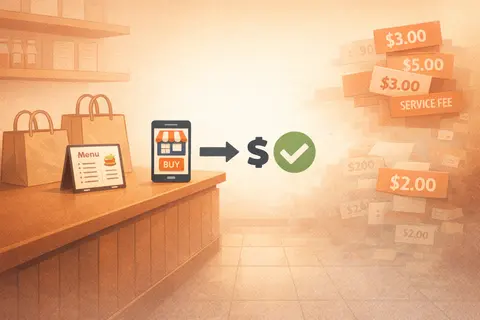
Restaurants usually feel the fee problem before they can name it
Most owners do not need a spreadsheet to know when third-party ordering is getting expensive. They see it in the way menu prices creep up, in the pressure to "make delivery work" on thinner margins, and in the awkward customer experience that comes from passing costs around the order.
The hard part is not noticing the problem. The hard part is separating normal payment-processing costs from marketplace costs that change the whole economics of the order.
That is the real reason zero-commission ordering matters.
Stripe fees and marketplace fees are not the same kind of cost
Every online order has to be paid for somehow. If a restaurant accepts cards online, there is usually a payment-processing fee involved. That is normal infrastructure.
Marketplace commissions are different. They are not just the cost of moving money. They are the cost of participating in someone else's demand channel, promotion system, and delivery stack.
That distinction matters because it changes the question a restaurant should ask.
Instead of "Does online ordering have fees?" the better question is:
"Which fees are unavoidable processing costs, and which fees are the price of renting demand from somebody else?"
For a restaurant that wants a durable direct-ordering channel, that difference is huge.
Commission-heavy ordering changes more than the payout line
When commissions get added on top of processing costs, restaurants usually compensate somewhere else:
- prices go up online
- delivery feels harder to price honestly
- staff spend more time explaining why the app menu does not match the in-store menu
- direct repeat behavior gets weaker because the restaurant is not really owning the relationship
That is why the fee conversation is not just about percentages. It is about what kind of operating habits the ordering system creates.
If every order arrives through a channel that takes a meaningful bite out of revenue, the restaurant starts building around that reality. Menu decisions, promotions, delivery decisions, and even customer expectations shift around the marketplace instead of around the restaurant.
What zero-commission ordering actually changes
Zero-commission ordering does not mean "free money." Restaurants still need payment processing, and they still need a system that customers can trust.
What it changes is the structure.
With OmNom, the restaurant-side pitch is simple:
- no OmNom commission on orders
- no monthly platform fee
- payments still process through Stripe
- the restaurant keeps the direct-ordering relationship
That simpler structure gives operators more room to make cleaner decisions. They can keep menu pricing closer to reality, spend less time reverse-engineering marketplace deductions, and think about delivery or pickup as an operational choice instead of a commission-management problem.
This is also a customer-pricing issue
Restaurant owners usually absorb platform economics one way or another. If the ordering stack is expensive, the customer often feels it too.
Sometimes that shows up as higher menu prices online. Sometimes it shows up as stacked delivery and service charges that make the final total feel disconnected from the menu.
OmNom's model is different because it starts from restaurant-side simplicity first. That does not remove every customer-facing cost in every situation, but it does remove the platform-commission logic that often pushes prices upward before the food is even prepared.
How to decide whether a direct-ordering setup is worth it
If you are comparing options, ask a few blunt questions:
- Are you paying mostly for payment processing, or are you also paying to stay visible inside someone else's marketplace?
- Can you explain the fee structure to a manager in one sentence?
- Do the economics make you want to raise prices online?
- Are you building a repeat-order channel you control, or renting one?
Those questions usually make the answer clearer than any sales deck.
Where OmNom fits
OmNom is built for restaurants that want a direct-ordering system without a platform commission hanging over every order. The point is not to pretend marketplaces have no use. The point is to give operators an owned channel that is easier to launch, easier to understand, and easier to protect over time.
If you want to see what that looks like in practice, read how restaurants can launch online ordering in 15 minutes or go straight to OmNom's setup flow.