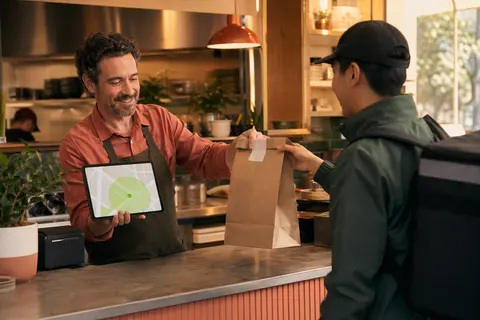
A bigger delivery radius is not always a better delivery strategy
Delivery can make online ordering feel more complete. It can also make the entire ordering experience feel fragile if the restaurant promises more than the operation can support.
The tempting move is to draw the biggest possible circle around the restaurant. More neighborhoods. More potential customers. More orders.
But delivery radius is not only a marketing decision. It is an operations decision.
Every extra mile affects food quality, driver availability, handoff timing, customer expectations, and the number of things that can go wrong after the kitchen has already made the food. A restaurant that keeps the delivery zone tight may look like it is accepting fewer orders, but it is often protecting the orders that matter most.
For a direct online ordering page, the better question is not "How far could we deliver?" It is "How far can we deliver reliably during a real shift?"
Radius should start with food quality
Some food travels well. Some food only travels well for a short window. Some food should probably stay pickup-only until the packaging, timing, or menu structure changes.
That means the delivery radius should start with the food, not the map.
Ask practical questions before widening the zone:
- How long does the food stay in good shape after it leaves the counter?
- Which items lose quality fastest?
- Does packaging hold heat, texture, and sauces well enough?
- Are drinks, desserts, or sides creating avoidable spills or remakes?
- Does the menu need delivery-specific item rules?
If the average order gets worse after twelve minutes in a car, a twenty-minute delivery promise creates a customer-service problem before anyone even places the order.
This is why delivery strategy and menu setup belong together. A restaurant might offer the full menu for pickup but a more focused version for delivery. That is not a downgrade. It is a way to make the delivery promise honest.
If the menu still needs cleanup before delivery goes live, start with the restaurant online ordering menu checklist first.
Driver capacity matters as much as distance
A nearby customer is not actually deliverable if no driver is available to take the order.
That sounds obvious, but many delivery experiences still treat the radius as the only gate. If the address is inside the circle, checkout proceeds. The customer pays. The kitchen starts working. Then the restaurant or platform scrambles to figure out whether delivery can actually happen.
That sequence creates stress in the worst possible order.
A stronger delivery flow checks capacity before it makes a promise. The customer should only see delivery as available when the restaurant is enabled for delivery, the address is close enough, and there is real dispatchable driver capacity for that zone.
Waitlist interest is not capacity. A driver who might sign up later is not capacity. A broad map is not capacity.
Capacity means the system has a realistic way to get the order from the restaurant to the customer after the food is ready. If that is not true, pickup should remain available and delivery should be clearly unavailable for that moment.
That may feel conservative, but it protects trust. Customers are usually more forgiving of "delivery is not available right now" than they are of a paid order that turns into a delay, cancellation, or confusing phone call.
Short zones make timing easier to explain
Delivery problems often show up as timing problems.
The kitchen is still working. The driver arrives too early. The driver arrives too late. The customer thinks the food is already on the way. Staff are trying to answer questions while the line is moving.
Shorter delivery zones do not solve every timing issue, but they make the handoff easier to reason about.
A compact radius helps the restaurant:
- set more realistic prep times
- reduce long gaps between kitchen finish and driver pickup
- avoid food sitting while a driver travels across town
- give customers simpler updates
- recover faster when one order runs late
The customer does not need every operational detail. They need clear states that match what is actually happening: the driver is on the way to the restaurant, waiting for the food, or heading to the dropoff.
Those updates make more sense when the delivery area is small enough for the operation to stay predictable.
Delivery should not be treated like pickup with a longer address
Pickup is mostly a restaurant-to-customer timing promise. Delivery adds a driver and a moving handoff.
That makes it a different product experience.
For pickup, the restaurant can usually create the order, prepare the food, and let the customer arrive. For delivery, the restaurant should know that a driver can accept the job before the order becomes a restaurant-visible commitment.
Otherwise, the restaurant can end up with food in progress and no clean delivery path.
The better sequence is more disciplined:
- customer enters a delivery address
- the system checks whether delivery is genuinely available
- the customer authorizes payment
- the delivery is offered to drivers
- after a driver accepts, the restaurant receives the real order
- payment capture and order fulfillment proceed from there
That sequence is more careful than treating delivery like pickup with extra mileage. It also gives the restaurant a cleaner operational boundary: do not start preparing a delivery order until the delivery side can actually support it.
A smaller radius can improve the customer offer
Restaurants sometimes worry that a smaller delivery zone looks less ambitious. But customers do not judge delivery only by coverage. They judge it by whether the experience feels dependable.
A tight delivery radius can support a better offer:
- food arrives closer to how the kitchen intended it
- delivery times are easier to keep realistic
- driver handoffs are less chaotic
- staff spend less time managing exceptions
- customers learn when delivery is actually available
That is especially useful for restaurants building an owned ordering channel. The goal is not to mimic a marketplace map. The goal is to create a direct ordering experience customers trust enough to use again.
If the restaurant wants delivery to be part of that channel, the radius should serve the repeat customer experience, not just the first checkout conversion.
Where OmNom fits
OmNom is built for restaurants that want direct online ordering without adding an OmNom commission or monthly platform fee. Standard Stripe processing still applies, but the restaurant-side platform model stays simple.
That matters for delivery because the restaurant can think about the real operating question: which orders can we fulfill well?
OmNom's delivery direction is intentionally short-haul and capacity-aware. Delivery should only appear when the restaurant is delivery-enabled and there is a practical way to dispatch a driver in that zone. When that is not true, the customer should not be nudged into a promise the restaurant cannot keep.
For restaurants, that means delivery becomes a controlled extension of the direct ordering page, not a vague hope attached to checkout.
If you are still setting up the basic ordering flow, read how restaurants can launch online ordering in 15 minutes. If delivery is part of your plan and you want to help build the driver side, join the OmNom driver list.
When you are ready to set up direct pickup and delivery ordering without restaurant-side platform commission, start from OmNom.