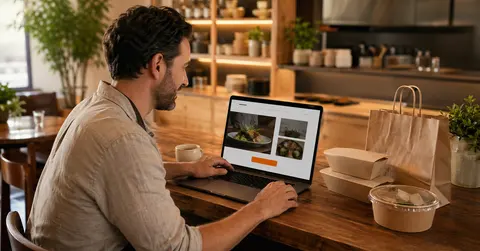
Most restaurants do not need a new website before they can take direct orders
One of the easiest ways to delay direct ordering is to turn it into a website redesign project.
That sounds reasonable at first. A restaurant wants the branding to look right, the menu to feel polished, and the homepage to look current. But in practice, that often means online ordering gets pushed back behind a longer list of design tasks that do not actually decide whether a guest can place an order today.
OmNom gives restaurants direct ordering with zero commission and zero monthly platform fees. Standard Stripe processing still applies. That lower-cost setup matters, but the real launch question is usually simpler: can a customer reach a clear ordering page from your current website without confusion?
If the answer is yes, you probably do not need a full rebuild first. You need a cleaner path.
Start with one real ordering destination
The most important part of adding online ordering to a restaurant website is not the button style. It is where the button goes.
Many restaurants still send order intent to a messy mix of destinations:
- a homepage with no obvious next step
- a PDF menu
- a marketplace profile
- a link hub with too many choices
- a menu page that still tells the customer to call the store
That path creates friction right at the moment the customer is ready to buy.
The better setup is one real ordering destination that already answers the questions a customer has when they are ready to place an order:
- what can I order right now
- is this pickup, delivery, or both
- are the hours current
- how do I check out on my phone
If your restaurant already has that page, you are closer than you think. If you do not, solve that first before spending time on a visual redesign.
This is also why owned ordering works better when it has its own live path instead of borrowing a generic website page. If you want the SEO side of that decision, read Restaurant Menu SEO Starts With Your Own Ordering Page.
You usually need only three placements, not a whole new site map
Restaurants often overcomplicate the integration step.
In most cases, adding online ordering to an existing site starts with three placements:
- A clear
Order Onlinebutton in the top navigation. - A strong homepage call to action near the first screen of content.
- A mobile-friendly order button that is easy to find without hunting through the menu.
That is enough for many restaurants to get moving.
You can add more placements later, but these three do most of the work because they catch the common customer paths:
- a regular customer who lands on the homepage
- a mobile visitor who wants to order fast
- a branded-search visitor who clicks into the site and looks for the obvious next step
What matters most is consistency. The button label should stay simple, the destination should stay the same, and the customer should not have to guess whether the "menu" page is different from the "order" page.
If your current website already has basic traffic, this kind of lightweight integration is often enough to start capturing direct orders without rebuilding the whole experience from scratch.
Do not promise more than the ordering flow can actually support
The website button is only useful if the ordering flow behind it is believable.
That means the restaurant still has to keep a few basics tight:
- menu items should be current
- hours should match reality
- prep times should be realistic
- modifiers should be readable for staff
- pickup and delivery options should reflect actual operations
This is where some website projects go sideways. The front-end button looks finished, but the ordering flow behind it still has mismatched hours, confusing modifier groups, or a delivery promise the restaurant cannot support consistently.
That is why the better launch order is usually:
- Make sure the ordering destination is real.
- Put the button in the places customers expect.
- Test the actual order flow on a phone.
- Improve design polish after the path is already working.
If you still need to tighten the setup before driving traffic, start with How Restaurants Can Launch Online Ordering in 15 Minutes, Restaurant Online Ordering Prep Times: How to Set Customer Expectations Without Slowing the Kitchen, and Restaurant Menu Modifiers: How to Keep Online Orders Accurate Without Slowing Checkout.
A quick operator test is worth more than another design revision
Before announcing online ordering on social media, email, or signage, walk through the full path like a real customer.
Open the site on your phone and check:
- can I see the order button immediately
- does the button lead to the correct ordering page
- do hours, pickup options, and item availability make sense
- can I finish checkout without pinching, zooming, or backtracking
- would a first-time customer understand what happens next
Then place a real test order.
That final step catches the problems that mockups never do. You see whether the handoff feels clear, whether the kitchen can read the ticket, and whether the flow actually behaves like a live ordering channel instead of a half-finished web project.
A lot of restaurants do not need a bigger digital project. They need a working path they trust enough to share.
Where OmNom fits
OmNom is a strong fit for restaurants that want direct online ordering without adding another commission layer or monthly software fee. Restaurants pay no OmNom commission and no monthly platform fee. Standard Stripe processing still applies.
That makes OmNom especially useful for restaurants that already have a website and do not want to rebuild everything just to start taking direct orders. If the restaurant already has branded demand, the smarter move is often to connect that demand to a clean ordering path first, then improve polish over time.
If you are deciding how much traffic should stay on marketplaces versus your own ordering channel, read Restaurant Repeat Orders: When to Use Marketplaces and When to Push Direct Ordering. If you want to get the direct path live now, start with OmNom or browse more practical operator guides on the OmNom blog.